

Someone Else Will Give
A slow, practical reflection on Surah Al-Muzzammil, Ayah 20 — and where our charity was always meant to start

﷽

Living by the Qur’an A slow, practical journey through the Qur’an
Issue 17 | Surah Al-Muzzammil | Ayah 20
Assalamu alaikom wa rahmatullahi wa barakatuh dear brothers and sisters,
A quick update before we begin.
I am still journaling and crafting du’as as I go along, and working on maintaining and improving my consistency for the sake of Allah ﷻ despite the setbacks.
How are you getting on? Let me know in the comments. I reply to every single one.
We are continuing our journey into the Qur’an. And today we are focused on the last ayah of Al-Muzzammil — chapter 73, ayah 20.
The Clear Qur’an describes this early Meccan surah as preparation: it readies the Prophet ﷺ for the commandments still to come and for the difficulty ahead, pointing him — in this surah and the next — toward patience and prayer as his comfort, while the arrogant among the disbelievers are warned of the punishment awaiting them.
And while the ayah heavily focuses on the night prayer, I want to focus on something different that we may sometimes overlook.
Allah ﷻ says:
The Enshrouded One (73:20)
۞ إِنَّ رَبَّكَ يَعْلَمُ أَنَّكَ تَقُومُ أَدْنَىٰ مِن ثُلُثَىِ ٱلَّيْلِ وَنِصْفَهُۥ وَثُلُثَهُۥ وَطَآئِفَةٌۭ مِّنَ ٱلَّذِينَ مَعَكَ ۚ وَٱللَّهُ يُقَدِّرُ ٱلَّيْلَ وَٱلنَّهَارَ ۚ عَلِمَ أَن لَّن تُحْصُوهُ فَتَابَ عَلَيْكُمْ ۖ فَٱقْرَءُوا۟ مَا تَيَسَّرَ مِنَ ٱلْقُرْءَانِ ۚ عَلِمَ أَن سَيَكُونُ مِنكُم مَّرْضَىٰ ۙ وَءَاخَرُونَ يَضْرِبُونَ فِى ٱلْأَرْضِ يَبْتَغُونَ مِن فَضْلِ ٱللَّهِ ۙ وَءَاخَرُونَ يُقَـٰتِلُونَ فِى سَبِيلِ ٱللَّهِ ۖ فَٱقْرَءُوا۟ مَا تَيَسَّرَ مِنْهُ ۚ وَأَقِيمُوا۟ ٱلصَّلَوٰةَ وَءَاتُوا۟ ٱلزَّكَوٰةَ وَأَقْرِضُوا۟ ٱللَّهَ قَرْضًا حَسَنًۭا ۚ وَمَا تُقَدِّمُوا۟ لِأَنفُسِكُم مِّنْ خَيْرٍۢ تَجِدُوهُ عِندَ ٱللَّهِ هُوَ خَيْرًۭا وَأَعْظَمَ أَجْرًۭا ۚ وَٱسْتَغْفِرُوا۟ ٱللَّهَ ۖ إِنَّ ٱللَّهَ غَفُورٌۭ رَّحِيمٌۢ ٢٠
Surely your Lord knows that you ˹O Prophet˺ stand ˹in prayer˺ for nearly two-thirds of the night, or ˹sometimes˺ half of it, or a third, as do some of those with you. Allah ˹alone˺ keeps a ˹precise˺ measure of the day and night. He knows that you ˹believers˺ are unable to endure this, and has turned to you in mercy.[1] So recite ˹in prayer˺ whatever you can from the Quran. He knows that some of you will be sick, some will be travelling throughout the land seeking Allah’s bounty, and some fighting in the cause of Allah. So recite whatever you can from it. And ˹continue to˺ perform ˹regular˺ prayers, pay alms-tax, and lend to Allah a good loan.[2] Whatever good you send forth for yourselves, you will find it with Allah far better and more rewarding.[3] And seek Allah’s forgiveness. Surely Allah is All-Forgiving, Most Merciful.
[1] The reward for your charity will be far better than what you left behind or what you have given in charity because it will be rewarded ten-fold, or even 700-fold, and Allah gives more to whoever He wills. See 2:261.
[2] i.e., giving for charity and good causes.
[3] This passage lightens the ruling mentioned in 73:2-4. So from now on, the believers do not have to stick to any of the portions specified at the beginning of this sûrah. Rather, they can pray whatever they can at night.
— Al-Muzzammil 73:20, The Clear Qur’an

A Different Perspective - That Used to Be the Norm
I will be focusing on:
“So recite whatever you can from it. And ˹continue to˺ perform ˹regular˺ prayers, pay alms-tax, and lend to Allah a good loan.[2] Whatever good you send forth for yourselves, you will find it with Allah far better and more rewarding.[3] And seek Allah’s forgiveness. Surely Allah is All-Forgiving, Most Merciful.”
Recently I was listening to a lecture, and the shaykh was talking about the fiqh of marriage. In this lecture he was discussing how sometimes finances will get in the way of young people getting married.
Now we know that our ummah has a marriage crisis, in particular for young people who are struggling not to fall into zina — some of them are — and they are really having a hard time getting married. And yet our ummah has an abundance of wealth.
And what the shaykh was suggesting was to give a goodly loan (charity/saddaqah) to these young people. To not just think about let’s give to charity, but to start with those near us who might need help to get married.
And I am not talking about the wedding. I personally am not in favour of big lavish weddings. I believe that money could be better spent giving it to the couple to start their life together.
And it got me thinking about my own idea of charity. We have gotten so used to giving to organisations for some of us, giving to poorer family members back home. And all of that I encourage you to keep doing. But what about those nearer us, in our own communities?
Instead of having that very narrow view on where we can give, what struck me in what the shaykh was saying is that we can have a direct impact in our own community, with people near us. For example, that couple, or that young man who wants to get married but has an issue of finances. I am pretty sure that a community could come together and help out.
And this is not a new or radical idea. It is in fact part of our Islamic tradition, still alive in some societies, but increasingly lost for those of us living in the West. How did we get here?

The Idea We Absorbed Without Noticing
Studies in the UK and US have shown that Muslims rank amongst the most generous. So I am not saying that our ummah is not giving.
Instead, what I see happening is this idea of: let’s not give a handout, to those in our community when it would go directly to the person. This is again not the case of everyone but I believe it still needs to be addressed where it is the case.
I had assumed this idea came from Christianity. When I looked into it properly, that turned out not to be right, and the real story is more uncomfortable, because it is much closer to us in time.
Direct almsgiving was central to Christian practice for most of its history. Pope Francis has publicly defended giving money to a beggar even if the man spends it on a glass of wine. The suspicion of the handout is a recent invention. It begins with Cotton Mather, the Puritan minister of colonial Boston, who argued that a benefactor should first work to cure the idleness of the person he was helping, and that withholding alms could itself be an act of charity. Benjamin Franklin carried it further, shifting the organising logic of giving from help to self-help. Andrew Carnegie took it to its conclusion in his 1889 essay “The Gospel of Wealth,” writing that neither the individual nor the race is improved by almsgiving. And by the 1870s it had hardened into an organised movement, so-called “scientific charity,” which sorted the poor into the deserving and the undeserving and investigated each family as a case to be solved before releasing any relief.
That is where “a hand up, not a handout” comes from. It is a particular Anglo-Protestant reading of poverty as a moral failure, dressed up later in the language of efficiency. And I challenge you to ask to what extent you see that we have absorbed this idea.
Whereas our deen is built on helping those nearer to us first.
What Our Deen Actually Says
When the companions asked the Prophet ﷺ where their giving should go, the answer began with the people closest to them:
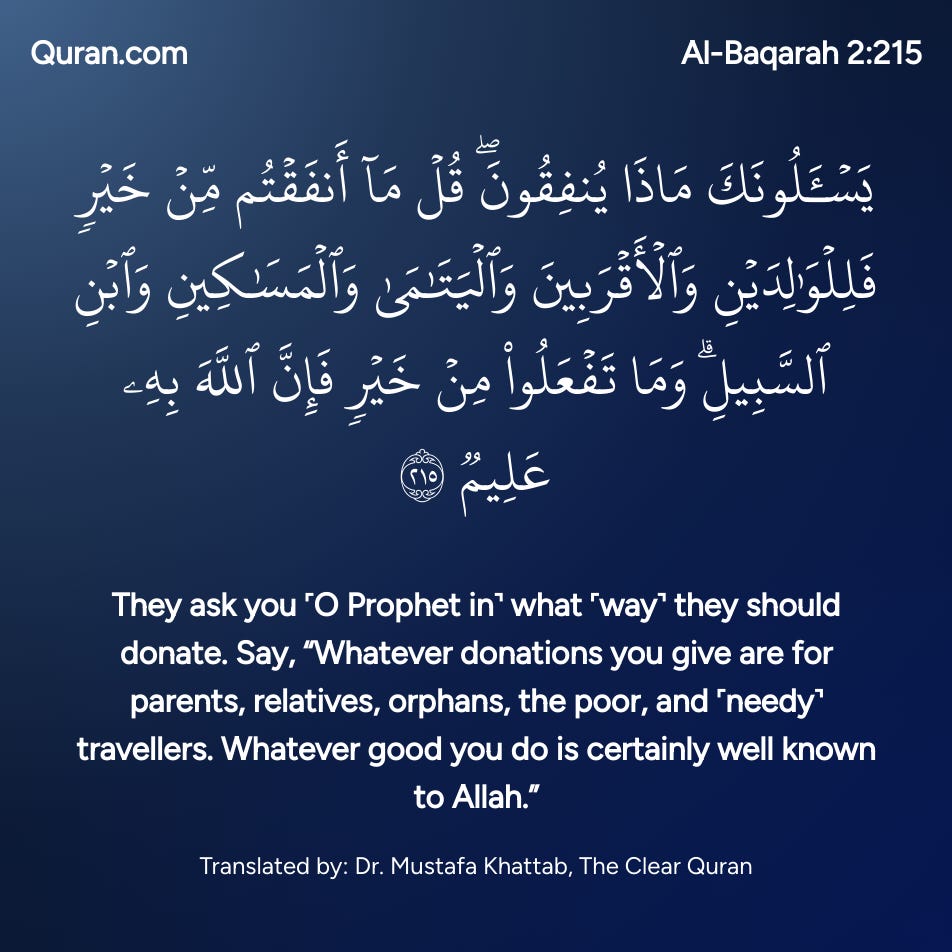
And the Prophet ﷺ tied our very iman to the person on the other side of our wall:
حَدَّثَنَا مُحَمَّدُ بْنُ كَثِيرٍ، قَالَ: أَخْبَرَنَا سُفْيَانُ، عَنْ عَبْدِ الْمَلِكِ بْنِ أَبِي بَشِيرٍ، عَنْ عَبْدِ اللهِ بْنِ الْمُسَاوِرِ قَالَ: سَمِعْتُ ابْنَ عَبَّاسٍ يُخْبِرُ ابْنَ الزُّبَيْرِ يَقُولُ: سَمِعْتُ النَّبِيَّ صلى الله عليه وسلم يَقُولُ: لَيْسَ الْمُؤْمِنُ الَّذِي يَشْبَعُ وَجَارُهُ جَائِعٌ.
Ibn ‘Abbas informed Ibn az-Zubayr, “I heard the Prophet, may Allah bless him and grant him peace, say, ‘He is not a believer whose stomach is filled while his neighbor goes hungry.’”
We have gotten into a habit of giving to countries, to places outside of where we live. But the original instruction on zakat was local.

The Discomfort I Found in Myself
I started to dig much deeper into my own self, and I realised that there was discomfort. I felt discomfort in giving, because of this idea of — oh, but how are they going to spend the money?
And I asked myself: is that really Islamic?
Now I know that in our deen we do it for the sake of Allah ﷻ, and of course, if we know someone is going to spend on haram, we are not going to do it, because we know already, we have evidence. But if someone is going to get married, or a sister who may recently have gotten divorced is struggling to pay her rent, struggling to take care of her children, or anyone we see in need and we are in a position to help, then is it not our job to simply help when we can, for the sake of Allah ﷻ, without actually expecting something in return other than the reward from Allah ﷻ?
Because Allah ﷻ says: whatever good you send forth for yourselves, you will find it with Allah far better and more rewarding.
And what I find most interesting here is that Allah ﷻ says: and continue to perform regular prayers. So, for example, if you are giving, do not let your fard obligations be affected by that. You need to find a balance. That is the beauty of Islam, it is a religion of balance and the middle road.
And for those who are able — lend to Allah ﷻ a good loan. To give for the sake of Allah ﷻ, to good causes. And what better cause than helping a young couple in our midst get married? Helping that young mother. Or that woman who has been married for twenty years, has been divorced, and is struggling to pay her bills. Or the woman who suddenly finds herself widowed. The needs and examples are endless.
I Remember a Girl
I remember a case in my own community: an eighteen-year-old girl whose father died suddenly of cancer. Quite unexpected — not a long time that he was ill.
Someone in her situation could use a goodly loan for the sake of Allah ﷻ — giving charity and helping her get up on her feet. Despite the fact that she had help from government officials, having her community come together and support her — not just in words, or a card, some flowers, but in a tangible way. A young girl who just lost her father, who has to learn all the skills of taking care of herself. She was provided with an apartment and some money to furnish it. But having someone in her community give from their wealth surely would make a life long impression, and it did because there were those who helped. Having that extra financial support helped her through that difficult time. Whatever support could have been given to her — as an example of what I am speaking of.
We often fall into: it’s not my problem. Someone else will do it. But instead, thinking — I am going to seek Allah’s ﷻ reward. I am going to seek His forgiveness. And I am redistributing the wealth that is not mine, but rather belongs Allah, to whomever Allah ﷻ wants to have it.
We like this idea of pay it forward, but actually paying it forward is very much part of our deen. We get from Allah ﷻ, and we are intended to also give for His sake.
We expect organisations to help. Or if there is a LaunchGood, we will participate in that. But what about those people in need who do not have a LaunchGood, who do not have a GoFundMe, who simply are in need, and we see them in our midst? What about stepping forward for the sake of Allah ﷻ and giving?

And What It Looks Like When Someone Does
I remember a friend, when she herself became ill with cancer, while I was ill. She gave to me on several occasions, because she knew that I was on a special diet which was rather expensive, and that I was doing it in order to be healthy. She simply contacted me, asked me for my bank details, and gave. It truly meant the world to me. When you are in need, knowing someone sees your need, your pain and they are willing to give, hits the heart in a special kind of way.
May Allah ﷻ reward her far more than she gave me Ameen.
And that is what I am speaking of — real giving. A goodly loan for the sake of Allah ﷻ, and not expecting anything in return except for the reward and forgiveness of Allah ﷻ.
The Promise Attached to Giving
And what I love about this ayah — and similarly in the Qur’an you will find ayat about giving charity — I am thinking in particular of Surah Al-Baqarah 2:268:
“The Devil threatens you with ˹the prospect of˺ poverty and bids you to the shameful deed ˹of stinginess˺, while Allah promises you forgiveness and ˹great˺ bounties from Him. And Allah is All-Bountiful, All-Knowing.” — Al-Baqarah 2:268, The Clear Qur’an
Again — after Allah ﷻ encourages us to give, He is also promising us His forgiveness and His great bounties.
And in this ayah Allah ﷻ promises that whatever you send forth for yourselves, you will find it with Allah ﷻ far better and more rewarding. And seek Allah’s forgiveness — surely Allah is All-Forgiving, Most Merciful.
We have here a promise. An encouragement to seek Allah’s forgiveness. And we have two of Allah’s names: Ghafūr(غَفُور), the All-Forgiving, and Raḥīm (رَحِيم), the Most Merciful. For more on these Beautiful Names of Allah see the links above,
What I Want to Leave You With
I want to end with a reminder, for all of us, and first and foremost for myself.
The wealth that we have been given by Allah ﷻ — however much it is, however little it is — it is Allah’s wealth that we have been entrusted with. And when we internalise that deeply, we first of all think: how am I spending my wealth? Am I spending it in a way that is pleasing to the actual owner of this wealth? Am I fulfilling that amanah, that trust He has given me?
Or — how am I not spending it? Sometimes the pendulum can swing the other way, and then we are holding on to money and being too stingy, and afraid to spend. Am I using, or not using, this money in a way that would be pleasing to Allah ﷻ — while also, in the process, seeking His forgiveness, and knowing that He is the All-Forgiving, the Most Merciful?
I want to leave you with that.
This Week
And this week’s encouragement is to reflect on where in your community you can be giving more. I am myself deeply reflecting on this — not just to reflect and move on, but to reflect and to give for the sake of Allah ﷻ.
And while I was focusing on giving money — which in this time of financial difficulty definitely matters, and those who have can help out those who do not have — you can give in other ways as well. You could give of your time. You could give of your knowledge. You can give, as the Prophet ﷺ said, a smile. And sometimes a smile can go a long way.
But dig deep inside of yourself, and start giving more for the sake of Allah ﷻ, and start forgiving more for the sake of Allah ﷻ. I intend on doing so, InshaaAllah.
May Allah ﷻ accept from us, guide us, increase us in beneficial knowledge, increase us in halal rizq, and accept our good deeds. Ameen.
Much love,
Nour Cauveren
P.S. Thank you to everyone who has subscribed. This newsletter now has 418 valued subscribers. We are on a mission — 10,000 subscribers by Ramadan, InShaaAllah! Share this with three people today. That is all it takes. May Allah ﷻ grant you the reward. Ameen.